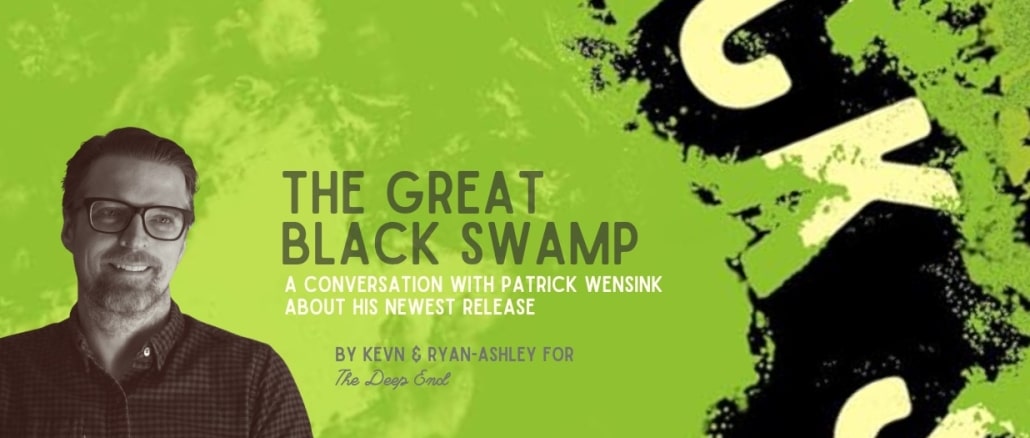
Everything’s Okay, Nothing’s Bad Here: Patrick Wensink in Conversation with Kevin Maloney and Ryan-Ashley Anderson Maloney

Unlike the dinosaurs, whose extinction was the result of a single cataclysmic event, humans are courting our own extinction with significantly less flair. While the results of our warming planet are catastrophic—more deadly storms, famine, disease, etc.—the increase is incremental. Many writers and scientists have used the example of the frog in a pot of boiling water… you don’t recognize the problem until you’re already being cooked alive.

In his new environmental memoir The Great Black Swamp: Toxic Algae, Toxic Relationships, and the Most Interesting Place in America that Nobody’s Ever Heard Of (Belt Publishing), Patrick Wensink addresses this issue head-on, focusing on a lesser-known but startlingly vivid example of human-generated climate change: bright-green toxic algae. 

The book opens on Lake Erie. More specifically, the toxic algae which bloomed bright green across Lake Erie like, causing a poisonous phenomenon which nearly killed 400,000 Ohioans. From there, Wensink tells a fascinating story of the algae’s origins that unfolds like a detective novel as we get closer and closer to the bloom’s source. Along the way, we learn about green slime, a swamp full of wolves, the author’s preoccupation with Nirvana, and the unraveling of his own marriage. 

The result is a near-impossible feat: Wensink has turned a complex, scientific issue with roots in Midwest history and industrial agriculture into a compelling, wildly readable page-turner. We (Kevin and Ryan-Ashley) spoke with Wensink via Google Meet from bed while still in our pajamas.


Kevin / When I was reading The Great Black Swamp, one line that really jumped out at me was: “This place is unique for its absolute lack of uniqueness.” You write about how you were rejected as a kid in Northwest Ohio—how people there prized normalcy while you were this weirdo. But over the course of the book, it seems like you come to love and almost defend this part of Ohio. Did your views of Northwest Ohio change over time? Did they change over the course of writing this book?

Patrick / While you were talking there, I thought of the dynamics in a sibling relationship. I can criticize you and I can give you shit if I’m your brother, but if anybody else does, I’m gonna step in and defend you. My relationship with Northwest Ohio feels a lot like that. 

We didn’t have record stores and nobody else was into the things that I was into, and so I got picked on. Over the course of writing this book, though, and thinking more deeply about my home and its history and my history with it, I realize that it’s all those things that made me the person that I am now. And I like me now. And so there’s a part of me that plays this sort of sliding doors game of like, well, if all those things hadn’t happened who would I be? I have a real appreciation for the oddity and the hard times and the complexity that I had to deal with growing up there. And I don’t think I fully understood it and embraced it until I was writing this book.

This book took five years to write and over the course of that time, I had a lot of life changes, which I mention in the book—my marriage fell apart and I started a new career as a teacher. The process was very reflective of my being able to take a step back and think more about who I am and where I come from and why it’s all important. And, you know, I think a lot of us probably have a complicated relationship with our homes. I have a complicated relationship with my home, and that’s a good thing.


Ryan-Ashley / I love when a book about a niche topic seems to take an autoethnographic approach, and I’m drawn to that framework because it makes topics feel personally relatable which might otherwise feel inaccessible. While reading, I thought about my own relationship with changing landscapes, of agriculture-polluted farmland … and I think this is one of the reasons that it is more accessible than it might at first seem to somebody who thinks this is a book about a swamp. Because it’s a book about something else. 

P / Yeah, I think that was part of realizing that my personal story had a place. These are the kinds of stories I like, the ones with human grounding. I’m not very good at reading academic texts. Even though I had to read stacks and stacks of them for this book, I didn’t want The Great Black Swamp to feel like an academic book, and I didn’t want it to feel like a piece of a straight-ahead, just-the-facts journalism, either. I wanted it to have humanity. 

I knew it was going to be hard to make farming and algae and ditches sexy and interesting, and the writing process reminded me of when my kid was little. I would, you know, add spinach into his spaghetti sauce because I had to trick him into eating his vitamins. And while I’m not trying to not trick people, I decided to weave the more serious bits together with stories both about me being little weirdo as a kid, and, you know, really personal, vulnerable stuff. And hopefully that services to humanize my journey as well, because I respond to that kind of stuff. Whenever I see an author who’s brave, admitting their faults and showing you their hard times, I’m like, tell me more. 


R-A / I really was drawn in by the way you consistently anthropomorphize the swamp and the natural environment. You bring into focus the period where people were trying to legislate the personhood of corporations, drawing a parallel between that and the fight for swamp personhood, and I’m curious about our specific relationship to nature. First, how you feel about the personhood and rights of nature, and, second, were the scientists you spoke with more sterile toward and removed from their subjects, or more personal?

P / The scientists I talked to were so enthusiastic and so smart and so willing to share. I noticed that they shared a really interesting commonality, many of them anthropomorphizing the environment when they talked about it. They would refer to trees as babies or old guys, and I thought that was really charming.

One scientist, when showing me different samples of algae, said, “This guy is not very toxic, but this guy is really toxic.” They had a way of making these feel like living breathing entities with individual personalities. And I think that added to their enthusiasm and their ability to make these things feel real. It worked on me that way, at least—the samples didn’t just feel like specimens in a box, they were like living, breathing characters. 

I kind of took that spirit and applied it to the swamp itself. Probably because one thing I discovered while researching was that there’s a real lack of characters throughout the history of the swamp. And in creative nonfiction, just like in a novel, you need characters and scenes to really make something like historical writing come to life. But it was a swamp the size of Connecticut where nobody lived until the 1890s, and there were just a very few pioneer records. So I needed to write the swamp with the same craft that I would a living breathing human being. 

For over a hundred years after the first people tried to settle the swamp, the swamp fought back. People would try to build a road, but then the road would wash out and the horses would get stuck in pits. They’d try to buy coffins, but the graves would flood, pushing the coffins back up to the surface. They built train tracks through the swamp, but it just swallowed them whole. So it did feel like a character, like it was in a good versus evil battle, relentlessly fighting back. 


K / How did it feel as a non-scientist, telling a fairly complex scientific story, talking to a lot of scientists who are extremely nuanced experts in their field? How did it feel coming in as an outsider? Did your confidence grow over time? 

P / I would not dare call myself an expert, but my confidence definitely grew over time. I was recently interviewed by some radio stations, and the DJs were talking to me as if I was a scientific expert and I was like, oh, I’m not very comfortable in this position. I’m a layman, and I’m pretty clear about that in the book. I think I mentioned that the last time I took a science class was like 1998, and I got a C plus in it. But I’m hopefully turning these deficits of mine into a positive. Instead of saying, I shouldn’t be the one to write the story, I’m like, Oh, I’m exactly the person to write this story, because the writing involves learning. And now I can maybe bring people along with me who also don’t know the science, making the information more accessible to them as well. 

I’ve written a lot of fiction, but I’ve also published a lot of nonfiction. I’ve written for the New York Times and Esquire, Oxford American—a bunch of really nice outlets—and my favorite and best pieces of journalism are always written as an outsider, just trying to figure out something really, really unique. And so I kind of like being a dumb-dumb. I like being the one who doesn’t know what’s going on. I find that to be a really powerful position as a nonfiction writer, because you can then seek out people who know so much more than you.

It took me a long time to lose my inhibition around ignorance. For a long time, I thought ‘not knowing’ was something to downplay. But then, as I got older and more experienced, I realized that I love being a student; being a beginner gives me the perspective to make heads and tails of something as complicated as ecological disaster even when I don’t know anything. Hopefully that also enables me to put it into language that makes sense for other folks who, like me, aren’t scientists either.


R-A / The word “normal” shows up in the book 76 times, and this amplifies the way that the desire for homogeneity is in direct opposition to what is natural. I think it’s a very Western, very American, thing to want everything to fit ‘just right.’

On page 218, you write about carrying on like nothing abnormal is happening, and that made me think about how, even after the EPA reached out warning that the water system was at risk, nothing was done. I’m assuming that it was the desire for normalcy, stasis, that led to this inaction, but I’m sure there are lots of reasons. 

I’m curious about the tension you might feel about the idea of normalcy given the destruction of the landscape and given your own history with feeling like you were sort of having to choose between nurturing the things in yourself that made you different, and cutting them out so you could be normal, fit in, suffer less. You were weird. The swamp was weird. People wanted to change you, and they also wanted to change the swamp. 

P / Yeah, people really tried hard to de-weird the swamp, and this is exactly the sort of contrast I was trying to create. I didn’t come out of the gate knowing that it was going to do these kinds of things; it was more of an evolution, and I leaned in as I saw the parallels to my own life becoming apparent.

I started this book intending it to be a straight piece of journalism about the history of the swamp and about the toxic algae. It was only when my personal life started really getting complicated and sad that I took a step back, and it dawned on me that so many similarities were at play.

I was always really excited about the book, but it really took on a new life for me and became invigorating when I saw that the decisions I had made in my own life in order to try and be normal, to maybe have normal relationships, and to suppress the abnormal parts of my personality, were so strikingly similar to not just Northwest Ohio and Lake Erie in particular, but the environmental picture in general. For example, we all know global warming is happening and yet we have been suppressing the knowledge and implications of that for decades in hopes that everything will just end up okay. 

I know lots of people are are pushing hard and fighting for change, but I think that the overwhelming perspective is, like, “Ehhhh, we’ll worry about it later. It’s okay. It’s going to be okay.” That mentality was so much of my own personality as well. Everything’s okay, everything’s okay, nothing’s bad here. I realized that this is such a human reaction and also a very Midwestern thing, because once I moved away from the Midwest, I saw a lot of people with healthier relationships to their feelings and to the world around them than me. Had I not moved away and had these opportunities, I don’t think I would have ever seen that in myself. So I’m lucky in that regard.

But it really wasn’t until a much later that I started identifying the parallels and recognized the need to put more of myself in the book. I had gotten bad advice early on to cut myself completely out of it. I was told that that the book was not about me. But I didn’t like that book. I wasn’t excited by that book. And the more I put myself into it, the more I thought, this, this is a book only I could write. And I like that.


K / Yeah, and it seems kind of like there’s this personal rewilding happening. A process of allowing for your own complexity, and nuance to surface. 

P / Exactly. That’s 100% what I was seeing and feeling and hoping that people would take away when reading the book. 


R-A / You’ve talked about how it was your curiosity and vulnerability which allowed you to write this book, a book which hinges on the accurate representation of scientific and ecological data and history which you didn’t already have the expertise to accurately illustrate. This feels like an important thing to think about in our current cultural moment.

In this moment, younger generations especially are being taught that as long as you sound like an expert, you don’t have to do the work of becoming one. There’s a pervasiveness narrative that you’re just supposed to naturally have ‘it’ all figured out and not need to ask questions. But this really creates a lot of divisiveness because when everybody is coming to the table with the posture of, I know, I know, I know …

P / … I’m an expert …

R-A / …yes! Then there’s like very little opportunity or reason to come together and just like discuss and wonder and posit.

Do you find that your students are able to be vulnerably curious? Were the experts you talked to surprised by your willingness to be vulnerable and curious and say things like, “I don’t know?” 

P / It’s funny you ask about students, because I’m teaching creative nonfiction this semester, and a focus is on making them comfortable with not knowing things and using that comfort and self-knowledge as fuel to learn more. This practice is not natural, especially in the academic world, because these students are either used to writing term papers that have to be an exact length with a specific number of paragraphs that adhere to a particular structure. It’s not common for someone to come along and say, yeah, I don’t know

I tell my students to just start flailing about, to start pulling information in to see how they feel about it and making heads or tails of it from there. It’s disorienting, I think, for a lot of students. And every once in a while I have somebody who really latches onto it, but for the most part, it’s confusing to be told it’s okay not to know, and to fail, and to totally blow it. 

Recently, I had them all work on different pieces that allowed them to follow their own interests. One student is writing about the Louvre jewel heist, but also referencing a time when her family’s house was broken into.

R-A / Autoethnography!

P / Yeah, exactly. I’m really trying to have them infuse their own lives into journalistic pieces. We did a section that was all memoir, but now I’m like, what if you put some research into this and, you know, mix it all up?

Another student is talking about using a fiber arts and knitting practice to manage mental health.

After they’ve done a round of research and maybe interviewed some people, I have them do an exercise where I say, “Okay, write down everything you know about your topic,” and that’s all they do for ten or fifteen minutes. Then, I Say, “Okay, now write everything you don’t know about the topic.” Inevitably, this is either something they haven’t thought of or something they’ve avoided, and they see the unknowns as a negative thing. I tell them that this is exactly the kind of stuff you should be exploring right now. These are the questions you should be asking.

The results vary, but when when you see somebody employing that practice in their interviews and research, that story inevitably starts to sing—it starts to take on its own voice, and it’s really exciting and interesting to see. Hopefully they feel that, but at the very least, they walk away knowing that it’s okay not to always know what’s going on, and it’s also okay to fail. 

The most surprising part of the entire book writing process was when I was interviewing scientists. I talked to a lot of environmental biologists and ecologists, and in every case, I was worried that it would be intimidating as somebody who knows almost nothing about science to talk to someone with such a scientific mind. But in every case, it was delightful. 

In my experience, people who are in the sciences were so enthusiastic about what they do and about their area of expertise that they just could not be happier than to tell me everything they know and to answer all my questions. They shared passionately about their slivers of the greater world and were happy to walk me through the information slowly, as if I were, you know, an alien who’s just learning the language for the first time. That was one of the best parts, I would say.


K / You were talking about teaching your students how to put themselves into their journalistic work. As a Gen Xer, I feel like I need to ask the grunge question…

P / I know exactly where this is going!

K / In a book about toxic algae and Northwest Ohio, maybe the most unexpected character to me is Kurt Cobain. You talk about how finding a Kurt Cobain biography was an important part of your youth and I’m just wondering if you could talk about where you were in the writing process when you decided this story belonged in this book? How does it relate to toxic algae?

P / I think that probably came up when I started finally seeing the parallels between ecological disasters and my own personal disasters and shortcomings. So when I was going backward and trying to untangle everything and saying, Why did Lake Erie turn bright green and almost kill an entire city of people? Like what caused that? It made me look at myself and say, What caused me to be the way I am? And the answer to that was just like the ecology—it was a complicated combination of things, like we all are: it was growing up in the country, kind of isolated and playing by myself a lot as a kid with a big imagination, but then also eventually going into the public school system and having to deal with the hierarchies and getting bullied.

Right around the beginning of the grunge era, when my mind was ready for something different, I found Michael Lazaret’s Come as You Are, a really good Nirvana biography which most people probably wouldn’t think of as being anything special. To me, though, it was really exciting and eye-opening because it was about the band and how they grew up in a small town. But it was also the way in which Kurt Cobain talked about his view of punk rock, which was all about being weird and being creative. His view was that just the act of making something makes you an artist. It makes you punk. Before that, I’d always wanted to be creative, and I always wanted to make things, but I was too self-conscious. So to see someone saying, You don’t have to have special skills, and I don’t have a special background, in a weird way, was exactly the kind of pep talk I needed, and I wasn’t getting it from anywhere else. I didn’t have a cool older brother and there weren’t any other punk rock kids at my school. So I found it in a book. And you take it where you can get it when you’re at such a volatile age, you know?


K / Yeah, and you seem to describe the black swamp itself, or whatever small parts that remain, almost like the cover of a metal album or something, connecting these images of your punk rock ethos with the wildness of the black swamp.

P / I definitely compare it to a heavy metal album because, at one point, it was It was six feet of mud, like, deep, and the tree coverage was so dense that you supposedly couldn’t see your own hand in front of your face in the middle of the day. It was filled with tons of snakes and wolves and bears, all things I didn’t know existed in Ohio, and the malaria rate that was so high at one point that it was considered the unhealthiest place in America.

All those things were pretty badass, and it was something nobody really talked about when I was a kid. I think people knew about it, but it wasn’t really celebrated.


R-A / Speaking of music, when Kevin and I were talking about the swamp a few minutes before hopping onto this call, we were talking about the density of the swamp and the wolves and I couldn’t stop thinking of the talking wolves in Lil Dicky’s music video for “Pillow Talking (feat. Brain).” Have you seen this?

P / I don’t know that one. 

R-A / I strongly encourage you to watch it. It’s like 10 minutes long—more of like a short film than a music video—but it’s… It’s hilarious. And I think that you would appreciate it. I’ll send you the link. It’s also disturbing, FYI, but in the best way.

P / Yeah, send it. I can handle it.


K / I’m curious about the end of the book. In the closing chapters, you explore the concept of rewilding, the intentional reintroduction of the swamp into Northwest Ohio, and it almost seems like the book is going to end on a hopeful note. Then there’s another chapter and it’s about Elon Musk’s chainsaw and the DOGE cuts. I’m curious about how Donald Trump’s election and the complete dismantling of so many important environmental agencies changed the book. Where where you in the writing process when these things were happening, and how did it change your view of the book’s conclusion and of the future of toxic algae?

P / That’s a really, really good catch, because the tone of that chapter is a lot different. The book was pretty much done by mid-spring of 2025 when my editor came to me and said something like, I think you should probably write one more chapter. I was exhausted at that point. I’d been writing the book for five years and had poured so much of my heart and soul into it. I was ready to leave it alone, but my editor, Phoebe Moghaeri, who is really excellent at what she does, said that there was an opportunity to be topical with all the change that was happening. She sent me an article about NOAA (the National Oceanic and Atmospheric Association) losing funding and people getting laid off specifically in Ann Arbor, Michigan, where I had interviewed people. She said there was too much going on politically that was relevant to the story not to write it in.

I pushed back at first, saying we didn’t know what was going to happen and that we didn’t have enough distance from it yet. And she essentially said, Yeah, but I think you’re kind of missing an opportunity to be relevant to the moment if you don’t do this. 

I knew Phoebe was right. She has had really great suggestions all along and I trust her judgement on these sorts of things. So I started researching again and re-interviewed a lot of the same people I’d spoken with before to see what their take was. I think it’s valuable to show these first dominoes, and I believe there are going to be some serious repercussions from the Trump administration’s funding cuts, from firing people at the EPA and NOAA and so many other really important organizations. So while I don’t know what the ultimate outcome’s going be, I think it’s not going to be good. And it did have an eerie echo to the Reagan era in the 1980s—a period I cover in the book—where he did a similar thing. We were making huge reparative environmental strides, but then he slashed everything by eighty or ninety percent.

It was really important and really valuable to show the chain of events then, and it’s just as important now. I hope it doesn’t get worse, but I’m not optimistic and the experts that I talked to were not optimistic either.


R-A / I also think it’s so important to document what’s happening right now. There’s so much censorship—language is being removed from government websites; the digital versions of critical articles that appeared in print and online are getting edited retroactively; and ethical journalism is practically extinct. I think it’s a necessary activist move to publish what’s happening as it’s happening. 

This makes me think of Rachel Carson and Silent Spring, which you mention in the book, and how important that text has been as a historical document. It’s important in part because of the ways it exposed the troubling environmental ‘management’ decisions that were causing massive ecological shifts and extinctions and I suppose the hope was that the exposure would prompt people to be like, oh fuck, like… what are we going to do? People didn’t know how bad it was going to get but they chose to take their chances and now here we are. As you know, the Lake Erie algae bloom crisis is just one of many, many examples of catastrophic disasters which threatened (and continue to threaten) public health and safety. The Flint, Michigan crisis which you mention in the book, for example. And I think we really need these records now more than ever.

P / These crises are happening with more frequency everywhere, which is why this book felt really relevant to me as well. The big bloom was the first newsworthy version of this, but now it’s happening with so much frequency there. It’s become almost commonplace, which again, speaks to the collecting shrugging. Everyone’s just being normal and acting like things are okay. But it’s not normal. It’s not okay. And we need to address these things.


R-A / Talking about this makes me think of the compression of time you describe when sharing the National Commission on Water Quality report from the late ‘60s: “Lake Erie had aged fifteen thousand years in the two hundred years since pioneers first settled on its shores.” That information feels simultaneously horrifying and almost too abstract to fully land, but you really brought this idea home for me with the image of you and your friends chasing the train in the late ‘80s yelling, water! water! As you said in the book, you were yelling for water because bottled water was such a novelty at the time; it wasn’t really even a part of the collective consumer consciousness. Now, just thirty-five years later, I carry a bag made out of material generated from water bottle waste. And all because of a big Evian marketing campaign, the launching of which shifted public opinion and consumer behavior in a similar way to the cartoon corn tract you wrote about.

Out of nowhere, Evian bottles showed up on a New York catwalk—part of a fashion show–and the message was that water equals good hair, good skin, beauty. The message was that people, women in particular, should carry a bottle with them wherever they go. 

P / It so weirdly all ties together, but it’s not publicly acknowledged. 


K / You connect the stoicism of Northwest Ohio—this sort of like, eh, we’ll be fine, everything’s fine mentality—to the way people learn about climate change and decide it’s easier to go back to normal rather than making big changes. In all the research that you did, and as an expert in Northwest Ohio mentality, do you have any thoughts on ways to shake people out of this complacency mindset or do you think this is just how people are?

P / I don’t know that I have the answer to that one. I think it probably takes firsthand experience, like something bad happening to you. But even then, who knows?

R-A / Like the locals you interviewed who recounted the toxic algae crisis as not such a big deal… the thing that stood out the most in their memory was that everybody had to drink bottled water for a few days. They very much embodied the, eh, it wasn’t so bad, mentality you’ve described. 

P / This was one of the biggest surprises after of all my interviews. I figured I’d go to Toledo and people would be like, oh, it was awful, it was horrible, but nobody said that and that was when it dawned on me that this is just a mentality, a very midwest mentality. And the more I talk to my friends from out there, the more I hear feedback that this is just how midwesterners operate. 

I was that way for a long time, too. It took me a while to come out of my shell. But now, I look at all the things going wrong in the world and think that if our posture really hasn’t improved and we still aren’t paying attention to climate change, then I don’t know what it will take.

K / Yeah, unfortunately. Oh, well. I guess this depressing note is as good a place as any to stop. 

We want to go ahead and get this live because, I don’t know if you know this, but the New York Times is very interested in what Pool Party’s doing and it could get you some really good press. 

P / Yeah, I’ve heard rumors.


Patrick Wensink is an American author and his latest book, The Great Black Swamp, is available wherever books are sold. His novel, Broken Piano for President, received increased publicity when the whiskey company Jack Daniel’s Properties sent a politely worded cease-and-desist letter to the author asking that he change the design of his book cover, which closely resembled the label on Jack Daniel’s whiskey. You can learn more about the controversy and his past work at patrickwensink.com
Equitable Access and Meaningful Support for The Arts

The arts isn’t optional in a free democracy (here’s something you can do)

(jump to action letter)

Since moving to Portland, I have seen art organizations close, arts funding diminish, and a focus on equitable access to creative opportunities, recede in favor of individual fundraising efforts. Beyond Portland, I have seen beloved literary journals and art organizations and small creative businesses, lose funding across the country. 

What can a single person do to combat this, especially in an economy where income inequality is at a historic high, where many of the most creative and arts-enthusiastic among us live precariously, with little extra to give? Some of us are able to go see more films at independent theaters, shop at local bookstores, subscribe to journals, and pay for tickets to art exhibits. But so many who previously could, now can’t. 

Small businesses and arts organizations are seeing both funding cuts and less money coming in the door for goods and services and experiences. People living in precarity, people losing creative gig work to AI, for example, have less room in their budgets and thus must trade enrichment for security. 

Kevin and I are doing what we can with Pool Party and by attending as many arts-related and creative events as possible, but we too feel the pinch, and find ourselves adjusting our activities accordingly–matinees instead of evening showings, dinners in instead of eating out, cost-checking books across local bookstores in search of used or discounted copies when we can find them. Sometimes resorting to Ama*on when the cost is otherwise too great.

So when I was randomly added to a mailing list run by PACE (Portland Arts & Culture for Equity) —not long before I was invited to become a board member at Refuge America in NYC—I felt that exciting and particular spark which can only come from the feeling of having something to do.

I felt this way in my early 20’s when I worked as a field organizer for HRC (Human Rights Campaign), when I managed the political County Commission campaign for a woman supporting same-sex marriage, running in a Republican district, and then again when I launched an investigation against a racist employer, one which ultimately led to the person’s termination.

That feeling returned in my early 30’s when I opened a gallery in Tennessee and joined Knoxville’s Maker City Council–an arm of the city’s economic development initiative–and served for close to three years developing and supporting initiatives designed to bolster the creative economy and make Knoxville an economically friendly place to the people who made it interesting. 

Now, I feel it every time I think of the small ways I am helping moving Refuge America’s initiatives forward—the primary goal being to support LGBTQIA+ refugees seeking asylum in America—and now, as I sit here writing an email to my mayor and councilpeople advocating for arts-related funding in Portland, OR.

PACE’s communications have given me a detailed view of what’s happening with city budgets and actions and, thankfully (because who has time for all this research), have provided me with stats and language to use when reaching out to my representatives. 

Today, they sent an email to the listserve asking for members to join them tomorrow at 9:30am to support the organization as Blake Shell testifies that “the federal arts reductions are a part of the attacks on democracy, not separate from that.” She will have three minutes to testify and the more people who can show up physically or write to/call our representatives this week, the louder the chorus of their constituents’ voices will be. 

In order to support this effort, I wrote an email which combined my own personal stake as well as the language provided by PACE and I’m including it below in case it’s helpful for anybody else wishing to act. Additionally, I have provided all the district representatives’ email addresses below so nobody has to spend time searching. 


My Email

(read below or jump to representatives’ contact information)


Dear Mayor, District 3 council people, and Arts and Economy Committee Members,

I am writing to you today as a member of PACE, but more importantly, as a recent transplant to Portland from Raleigh, North Carolina. When I decided to move here in 2023, PNCA still had a community arts program; RACC’s funding hadn’t yet been gutted; and there were significantly more small, thriving galleries and arts organizations throughout the community than there are now. 

It pains me as an artist and an arts lover to see my reasons for moving my home and life across the country for a more robust liberal and arts community, disappear. Even a year ago, things weren’t quite so dire, and it was at this time that my husband and I decided to start a literary arts journal and reading series. It has gone so well that we have expanded into a publishing house with plans to incorporate and publish our first manuscript in 2026.

When we began this project–designed to uplift artists and writers–we were counting on being able to apply for grants in the near future. Now, we are concerned that with diminishing financial options, our vision for providing the community with more of the kind of creative enrichment that helps local businesses and all of its citizens thrive, may be limited. We won’t stop our work, of course, but right now it’s just the two of us volunteering our time, and we had visions of contracting other local talent like graphic designers and editors to assist with our work. It’s small gig opportunities like this, coming from many sources, which make up a meaningful, stable, life for so many creative gig workers here in Portland. 

In lieu of meaningful support from the city of Portland, many organizations will lay people off, replacing creative staff with artificial intelligence tools. Others will close. But AI isn’t a solution. Designed originally for increased efficiency to support humans, not to replace them, AI tools are no replacement for human ingenuity. For meaningful programming to exist in Portland, meaningful and strategic communications must be produced–press releases, advertisements, articles, digital marketing materials, exhibition statements–but these materials historically created and produced by people, designed with nuance and subjectivity and curiosity, will likely be replaced by ‘content’ drooled out by inexpensive AI programs in service of keeping doors open on shoestring budgets. This is just one of many concerns and costs (human and environmental) at hand. 

I wonder how children living in a place with increasingly empty storefronts and decreasingly available access to the arts, respond. I imagine a child’s vision for themselves narrows without prolific examples of what ‘thriving’ creatively might look like. I  believe access to the arts provides kids with the language they need to understand themselves, to build the confidence necessary to be curious, kind, productive members of their community. 

Because creativity doesn’t thrive in precarity. It suffocates. And so do the people working in the arts here, many of whom are already seeing a decline in work alongside a rise in living costs. The balance sheet just doesn’t balance, and I believe the below stats makes this painfully clear.

*Portland’s arts funding challenges are rooted in scarcity. According to SMU DataArts, we rank 17th in the nation for artistic vibrancy but 172nd for government support. Our arts thrive despite—not because of—government funding. 

In New York, SMU reports that 48% of artists make a living on gigs or freelance work, and only 8% are full-time workers. In our smaller arts economy, that gap is likely even wider. The“Big Five” are important employers, but they are not the primary source of income for artists here. Most artists earn through gigs, teaching, and creative side work that keeps this ecosystem alive.

Last year, the Office of Arts and Culture removed equity metrics from the Art Tax grants and distributed funds solely based on budget size. As a result, 45 of 80 groups lost funding, while only the “Big Five” saw increases.

Smaller orgs regularly employ Portland artists and offer affordable—often free—arts access across our neighborhoods. Prioritizing large institutions with endowments, greater funding, and fewer local artists is funneling money to money and power to power.

The Art Tax supports K through 12 arts education and making arts and culture available to underserved communities. In 2024, that mandate was changed without warning or oversight. We met with the Office and multiple committees, yet no corrective action was taken. We are now entering a second year of harm to our communities. 

Portland voters expected the Art Tax to expand access, not diminish it. We ask the City to restore funding for the 45— and to realign arts funding with its original intent: prioritize groups that provide low- or no-cost access, employ local artists, and do deep community work with underserved Portlanders, all without other significant funding.

Our vision is clear: support smaller orgs offering greater access citywide and the artists who make Portland what it is. We need explicit equity and access measures protected from politics, and as costs rise while the Art Tax stays flat, we need change to provide more funding overall. 

There are over 500 arts nonprofits here and most don’t receive city funding.

The arts give us agency, community, and the power to imagine change—that’s why they’re under federal attack, and why we must protect them locally.

We’re asking for a bold vision in support of the arts. Help us keep Portland as vibrant as the artists who live here.

Warmly,

Ryan-Ashley Anderson 

*Everything written after asterisk was provided by PACE


Contact information for Portland representatives


Mayor Keith Wilson: [email protected]

Arts and Economy Committee: 

Committee Chairs

Committee Members


District 1 Leaders

District includes these neighborhoods: Argay Terrace, Centennial, Glenfair, Hazelwood, Lents, Mill Park, Parkrose, Parkrose Heights, Pleasant Valley, Powellhurst-Gilbert, Russell, Sumner, Sunderland, Wilkes, Woodland Park


District 2 Leaders

District includes these neighborhoods: Alameda, Arbor Lodge, Beaumont-Wilshire, Boise, Bridgeton, Cathedral Park, Concordia, Cully, East Columbia, Eliot, Grant Park, Hayden Island, Hollywood, Humboldt, Irvington, Kenton, King, Lloyd, Overlook, Piedmont, Portsmouth, Roseway, Sabin, St. Johns, Sullivan’s Gulch, Sunderland, University Park, Vernon, Woodlawn


District 3 Leaders

District includes these neighborhoods: Ardenwald-Johnson Creek, Beaumont-Wilshire, Brentwood-Darlington, Brooklyn, Buckman, Creston-Kenilworth, Foster-Powell, Hosford-Abernethy, Kerns, Laurelhurst, Madison South, Montavilla, Mt. Scott-Arleta, Mt. Tabor, North Tabor, Richmond, Rose City Park, Roseway, South Tabor, Sunnyside, Woodstock


District 4 Leaders

District includes these neighborhoods: Ardenwald-Johnson Creek, Arlington Heights, Arnold Creek, Ashcreek-Crestwood, Bridlemile, Brooklyn, Collins View, Eastmoreland, Far Southwest, Forest Park, Goose Hollow, Hayhurst, Healy Heights, Hillsdale, Hillside, Homestead, Linnton, Maplewood, Markham, Marshall Park, Multnomah, Northwest District, Northwest Heights, Old Town, Pearl District, Portland Downtown, Reed, Sellwood-Moreland, South Burlingame, South Portland, Southwest Hills, Sylvan-Highlands, West Portland Park, Woodstock


In a moment where devastating headlines populate our newsfeeds twenty four hours a day, it can feel like there’s nothing anybody can do. But everything big was once small, and it matters what we do in our neighborhoods. It matters what we ask of our local governments. And I encourage anybody who can, to either write an email using the script above or choose another organization in your community to support in a similar way. A few ideas—prisoner letter-writing initiatives, refugee support organizations, LGBTQIA+ support organizations, and mutual aid groups among others can all benefit from people writing emails like the one above. Animal rescues and soup kitchens and youth support initiatives and art organizations all need volunteers, too.

There’s something for everybody who wants something to do in a moment that feels like nothing will help. 

Learn more about PACE. Learn more about Refuge America.

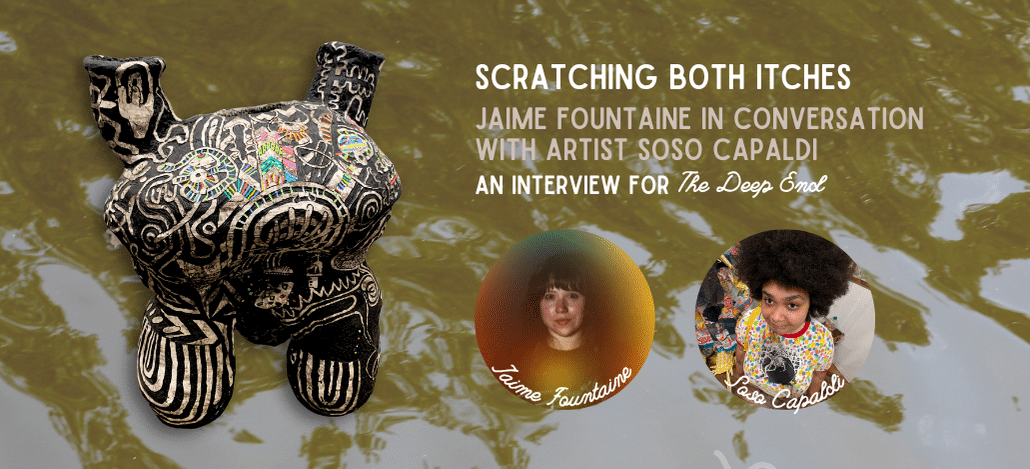
SCRATCHING BOTH ITCHES: JAIME FOUNTAINE IN CONVERSATION WITH SOSO CAPALDI

As I helped with the load-out after the closing of their most recent show, “Entity Cramming” with Eric Anthony Berdis at Grizzly Grizzly in Philadelphia, it struck me that, even though Soso Capaldi and I…

Group dynamics, intimacy between strangers, and rehearsing for loss: A review and conversation between Autumn Joi Knight and Ryan-Ashley Anderson Maloney

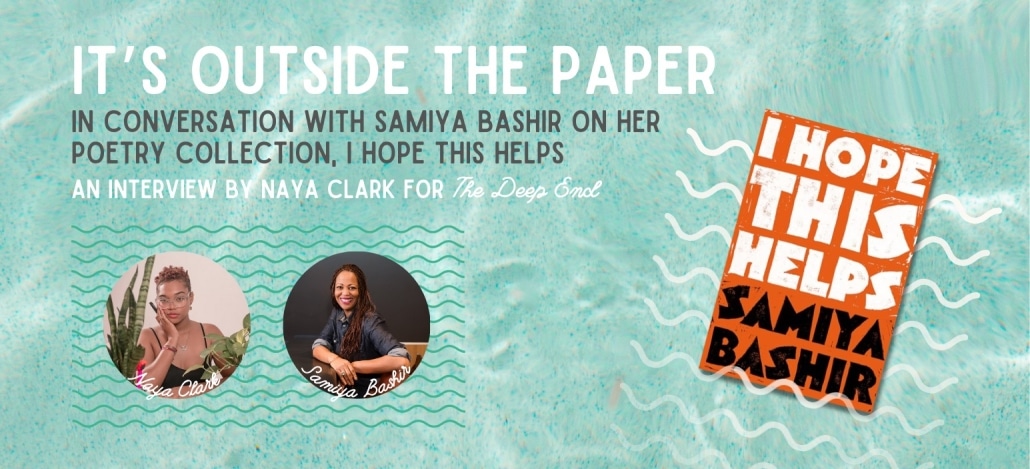
It’s Outside the Paper: In conversation with Samiya Bashir on her poetry collection, I Hope This Helps

Interview by Naya Clark

Samiya Bashir’s critically-lauded, multimodal poetry collection, I Hope This Helps (2025, NightBoat Books), begins with a quote from actress Niecy Nash-Bett’s 2024 Emmy award acceptance speech: “I want to thank me for believing in me …” This bold tribute, which echoes Snoop Dogg’s words six years prior during his Hollywood Walk of Fame ceremony speech, sets the tone for much of what’s to come in her latest poetry art collection.

Published just a few years after Field Theories, which uniquely interweaves quantum physics and Black embodiment, I Hope This Helps is the fourth poetry volume by the acclaimed poet, multimedia artist, essayist, and educator, and it promises to have at least as much impact as its predecessor.

In addition to her poetic accomplishments, Bashir is known for her opera Cook Shack (commissioned by the Opera Theatre of St. Louis as part of their inaugural New Works Collective), produced with composer Del-ShawnTaylor, and for leading Lambda Literary’s revitalization efforts as Executive Director from September 2022 through November 2023. She most recently served as the June Jordan Visiting Scholar at Columbia University in New York, and holds the 2019–2020 Joseph Brodsky Rome Prize in Literature—a distinction that resonated deeply as she became the first Black woman to receive the prestigious honor.

I Hope This Helps is an amalgamation of poetry and prose works laced with unique visuals that help expand the richness of the multimedia poetries. Experimental layouts, haunting illustrations, and suggestive sheet music punctuate the legible written words while unique typography choices—type that plays with shades of black and gray, that toggles between bold and italics, forces breaks with extreme spacing, and incorporates emoticons—make the reading of I Hope This Helps a physical experience. The addition of a QR code, which directs internet users to full bodies of work that continue off of the page, acts as a digital footnote, thus creating a truly multimodal and embodied one.

In the recurring series, M A P S :: a cartography in progress, for instance, installments are speckled throughout the collection using a black-out poetry method that transmutes existing language into new forms. The video iteration is accessible here and via the QR code at the back of the book as well.

Another piece that plays with form is HOW NOT TO STAY UNSHOT IN THE U.S.A, a two-page spread of all-caps actions listed one after the other which combine to tell the resounding and crushing story that there is no way for a person in America to feel totally protected from the possibility of being victimized by gun violence. The possibility is only amplified for folx who belong to marginalized communities and are deemed as ‘other’ by the American political and social system. ‘Offenses’ such as “BE PATIENT,” “HAVE A GUN,” “DON’T HAVE A GUN,” “BE GAY,” “GO TO CHURCH,” “BE AT HOME,” along with many haunting others, shout futility from the pages, highlighting how the looming fear of becoming a target makes for a dizzying existence for people in America—especially people of color, immigrants, women, and those within LGBTQIA+ communities.

Each of Samiya Bashir’s pieces combine to create a whole which, together, convey a richly quilted experience that helps the reader feel closer to being understood, closer to feeling part of something bigger than themselves.

In this interview, Bashir and I discuss multimodal art forms, her relationship between art and writing, and what it’s like to make art through an ‘American’ lens despite existing in its margins.

Naya Clark

I love that you start with a Niecy Nash quote. Can you go into how you decided to preface what we’ll be seeing, reading, and listening to with that? It kind of feels like permission to acknowledge yourself and could otherwise be taken as almost self-indulgent, perhaps.

Bashir  

It’s the opposite. My fear is that it will be seen as self-indulgent, but the reality of why it’s there is because it’s so real, because the undercut is that I’m living in a world that not just refuses to believe in me, but insists on the opposite of me. I have a line in “LETTER FROM EXILE” [that says], “Most days America screams to anyone who’ll listen how it hates me so much / it would rather kill us all than let me live.” That’s America. That’s where I live, that’s where I’m from, that’s who I am, right? The thing is not just that this work would not exist if I didn’t somehow believe in me, but I have had to work hard and continue to—every day, all day—believe in me, because everything around me says I am not a thing to believe in. [I] trust myself to make work. It’s not a small thing, and I fight it every day. [Quoting] Niecy Nash as the opening to the book is really important to me because we can’t do this if we can’t somehow find a way to keep going. When I had the exhibition in Michigan at the beginning of this year for I Hope This Helps, one of the students in some Q&A [said], “You’re so fearless. How are you so fearless?” And I was like, “Oh, I’m terrified all the time… This is not fearlessness… I’m afraid, and I have to find a way to insist on doing it anyway.”

Clark  

Do you feel a lot of this work is facing those [fears] head on?

Bashir  

There’s no other way… I can face [fear] from the side, I can face from the back. I can come in through the old milk door in my grandmother’s house from the milkman days. But at some point one must stand one’s ground. June Jordan said, “We are the ones we are waiting for,” so we have to show up. We don’t actually get a choice in that.

Clark  

You say you have no choice, but you make a lot of choices, especially with format. This is a whole multimedia project. And even one of the first poems, “OVERHEARD” plays with poetics. How do you decide when to toggle between various forms?

Bashir  

The active agent there is me, but there’s listening, which is where I feel I really am getting to the work, in which the active agent is the poem. My decision is always to trust the poem to know what it needs. That trust helps me to identify and feel its form.

Clark  

So it’s already existing. It’s a living thing beforehand?

Bashir  

This is about the work, and how I can be of service to this work. What that also means is that the poem is not just a thing I made up. It’s a thing that needs to be made, and I have the privilege of being called upon to make it.

Clark  

You write in “OVERHEARD,” “Once returned, I’m reminded how this whole business of writing, of sharing / is just not about me, and for good reason.” I think that’s such an omnipresent perspective of the work that you do.

Bashir  

I come from a world that’s very clear that it’s not in any way about me, so to say that something is about me is kind of a revolutionary act. I want to be clear about when I engage [with] that, and when it’s right. I don’t believe that the art I make is about me. I think it’s about us. But I also don’t necessarily believe in a me that is supercilious to us.

Clark  

You take a more conversational approach with “OVERHEARD.” I appreciate how accessible your work is—so much of it feels like how we [may] think and how we talk. You’re not trying to be overly flowery, and you’re not trying to put yourself in the confines of structure and language. One of my favorite parts in “OVERHEARD” is where you say “AND WHAT AM I TO BE—RAW OUT HERE? Entrails all exposed? / Skinless?! Nah, B! Nawwwww.” How did you make that decision?

Bashir  

Everything is written, revised, rethought, made clear.

Clark  

I mean, there’s emojis.

Bashir  

It was what I meant. ¯\_(ツ)_/¯

One poem was published in an anthology before the book came out, but the anthology publishers [suggested] I replace those [text emoticons] with the actual emojis and I was like, “No, no.” I personally am a little obsessed with the language of captions…[when] you’re watching something—I’m fascinated by the way they reframe what’s happening… It’s important to be clear about how we think about things, how we represent things to each other, and then how we also experience it. If you’re writing, you have to filter your experience into these letterbox spaces… That is a wrestling with language.

I am in love with language. I am also the greatest critic of the English language. It’s not my jam. It’s my native tongue, yes. The most fluent language I speak, and probably will ever speak in my life. And I also think it’s probably one of the least poetic languages on the planet. American English is a miracle every day. But what I’m doing here is not flowery because I’m actually trying to communicate something. I’m not trying to talk over or around you.

One of my great pet peeves is the way poetry is taught as a puzzle you’ll never be smart enough to solve… [I Hope This Helps] is not trying to trick you, because why would I do that? That’s beside the point. How could it help if it’s all a trick, [or] it’s all a joke? I Hope This Helps—the earnesty of the title is real. If you were at a reading, I would be looking you in the eye. I’m not speaking to the middle distance. I’m really trying to talk to you.

Clark  

It’s not all words. There’s line breaks, parentheses, brackets, [and] em dashes. You play with font size and boldness, color [and] white space. What is your process in deciding pause? Or a moment for the reader to take a pause with a space or a symbol.

Bashir  

This work—it’s very embodied, right? I think of poetry as primarily an oral art…right through the ear, through the body. [It’s] something that we’ve carried in our bodies long before writing. Language is not just words. We talk about body language. That’s a real thing.

When we talk about spoken language, I think that the breath [and how it’s scored] is critical. I really do agree with the idea that what you see on the page…that’s not the poem. That’s just a delivery system to get the poem from my body to your body… It’s a musical score sheet. If you’ve ever read music, the idea is: I can take this beautiful piece of music, put it on paper, and you can pick it up with your instrument, follow that on the paper, and play it. That’s what I’m doing on the page with the poem.

There are times when a semicolon is going to do something and a colon is going to do something, and a stanza break is going to do something else, and a line break is going to do something else. Or a long deep breath, which I might have to put in brackets to tell you: No, I really mean take a long, deep breath.

I tell my students, [to] read poems out loud. Don’t just sit there and read them silently. There’s sound happening here, and sound does something to our bodies physically. If you go to the movies and you see how they’re scored…the music has been set up to do this to our bodies in advance. That’s what poetry has the opportunity to do as well if you’re scoring it right. [Sometimes] the language that I’m working with in video poetry is about light and the dust in the light and the color and the movement of the body. Sometimes, if it’s in performance, it’s again in the body.

I think of I Hope This Helps, the installation piece that’s focused on the Standards, as a performance. One where my body steps out so your body can step in, the performance as you move through these 20 Standards hanging in space. It’s listening [and asking], “What does this poem need?” This poem is not just about words. This poem is about something much bigger. Poetry does something to us. There’s a reason. It’s perhaps the oldest art form that exists…aside from and alongside cave paintings. We’ve done this since we’ve had language…

Clark  

Have you always been experimenting with these forms or is it something that you evolved into?

Bashir  

I guess the answer is yes. I mean, I think in terms of writing and making…I’ve always been experimenting. But what [I experiment] with grows as I grow. Being able to play with language, play with grammar, play on the page, versus dealing with performance—all of these things are different areas, and so many of them have opened up in my poetry.

Clark  

I’m just always thinking about how you have to kind of learn the rules to be able to break them. You have to learn those rules of grammar to know how to play with the rules of grammar. Same with music, for instance.

Bashir  

Yes. You can’t be a dancer if you don’t have any relationship to gravity, right? But this is dance, and you have to understand how space and force and measure and gravity work. It’s the same thing I used to teach [in] dual workshops with my dance colleagues when I was at Reed College. We would do composition workshops, because poetry composition and dance—they’re two different things. But also, are they? How do we think about what we mean when we’re using this language, and what we’re doing with it, and how they might be in concert [or] in conversation, and help each other think about [them] in different ways?

Clark  

Speaking of movement and structure, this is a full collection, all the pieces living with each other. How do you work with something that’s meant to stand alone versus something that’s meant to be in a collection? Do you make every piece separately, [or] are you thinking about it as a family?

Bashir  

Everything can stand alone, but that doesn’t mean it’s not part of a conversation. I think about my work really in terms of conversation… When I think about sending work out for publication, magazines or journals, it’s like I’ve got this kid [who] now gets to go out and play, gets to go to school, gets to meet other friends and be in conversation with what’s happening in the world. That conversation is everything. It’s what it’s there for… It’s not about me. I might have made this thing, but it actually exists outside of me and beyond me, and I have to let it go and live its own life… You get to kind of see what that is, which for me is always a surprise. Now I get to sit down and listen to the work say, “This is who you are. Let me help you be who you are.”

Clark  

I’m also thinking of your lengthier poems like the MAPS series. I know that there’s no right or wrong way to perceive poetry or collections, but what was your process in making that a series? Was it one long thing and then you broke it up? Or was there a theme that you saw and decided they all belong together?

Bashir  

Actually, it predates my last book, but I knew it didn’t belong in that book… It’s a found poem project pulled through a novel called Maps by Somali literary legend [Nuruddin] Farah. That novel is breathtaking. It’s part of his Blood in the Sun trilogy and the whole series is breathtaking. All of the language in [my Maps series] is pulled from that novel, and it creates a whole different story. There’s definitely a tension between a mother figure and a lover there, and tension between how one maps one’s own coming of age, one’s own becoming, one’s own existence in a world that is actually not here for our wellness [or] our existence. It’s always a cartography in progress… It’s a project that I don’t know will ever be finished. I still have not completed pulling language from that novel. But this is the piece as it is now, as it needs to be in an unfinished state. I may continue to add to it…over time, but I think what it needed to be was presented and clarified—as this is a process of becoming, not a process of having become.

Clark  

Another thing that I noticed is that you are not afraid to say, “I don’t know.”

Bashir  

It’s probably the truest answer I could give to most things.

Clark  

There are also places where you have more blanket life statements. The things you feel you know, how do you know [when] to put it in a poem?

Bashir  

I get by with a little help from my friends. We show each other the work and help each other find paths toward understanding and at some point I have to trust and believe, not just that I’ve learned a few things—but that there might be some value to that. I also have to trust [that] what I know through deep experience and observation and understanding and thought and work, is also what I have to offer… So if I keep it a secret then, well, that just feels kind of selfish and not really helpful.

Clark  

I also want to know about incorporating photography, typography, [and] sheet music. What is the logistical process of speaking with your editor or publisher, and getting on the same page?

Bashir  

I mean, one thing I want to say full stop is that I am grateful to Nightboat Books, Stephen Motika, the publisher; Kazim Ali, the founder; and the whole team there. Stephen and Kazim have really believed in me and my work… This project is important because it’s about a collaborative building… That is also one of the guiding principles of this book… I don’t actually want you to read all the texts. I want you to see how the text and the images work together. Then you can go and actually see the video and hear the music, hear it through the voices and the bodies of the singers, and see how all those things work together.

The video poem, negro being:: freakish beauty—same thing. It’s just a transliteration. You have to go see the whole piece yourself. “DARK MATTERS” is the same thing. It’s on Spotify. Go hear it. But you can see what we’re doing when the musical notes mash up with the language notes, which then come together to build a whole new language, which is a whole new piece.

That’s what I’m working to recreate for you in book form… This is beyond book form. This is just the ink-on-tree version of this. [If] you want to hear, see the whole thing, experience the whole thing, it’s outside of the paper. If I’m delivering it right, soon it might be in your body too.

Clark  

I feel a lot of writers or artists may feel restricted by what they do and the form that they feel or have been taught that they need to take. From your perspective, how might a writer or an artist know that their work may work best as multimedia?

Bashir  

One of the things that I think we’re culturally stuck in right now is this fear of failure, fear of being wrong. [That] if you say the wrong thing, [you’re] gonna be canceled and it’s over, and [you’re] gonna be mocked, and [your career/life is] done. But we have to be willing to try something. Many of the things that I do with this work, I didn’t know how to do before. But I had to do it, so I had to learn. (Fortunately, learning might be one of my favorite things!) So I figure out how to do something, because that’s what the poem needs. And I probably had to try many different things before I got it.

In my last book, I have another series called “Coronography”, which is a double sonnet crown. It’s really busting through the sonnet form to do the work that those poems needed. So I have to really move through the form and understand what it does, then I can know how I can use that form to do what the work needs it to do. That doesn’t mean that I need to blindly follow a rule. I need to understand the rules and know why they are there and what they exist to do. Then comes what I need to do with them.

Clark  

You mentioned a large part [of I Hope this Helps] is collaboration and relies on having a good publisher, good people that you can ask, “How do I do this?” or, “How can we work together to do this?” What’s an example of something you didn’t know how to do that you needed to turn to and collaborate with someone else with?

Bashir  

The piece called “Here’s the Thing:” which only exists because I had been commissioned to write a libretto with a composer for a choral piece structured for a chorus and orchestra. It was my first time working with a 250 person chorus and a bazillion person orchestra. [It was] my first time working with this composer too, and as [I was] working to get this libretto together, what became clear for me and this process…is that I had to write it as a poem [first], and that’s what set the libretto free. Then I could write the libretto.

Clark  

With the constant doom and the feelings that everyone was experiencing [since Covid], how did you decide to write about this?

Bashir  

One of my great heartbreaks—probably of my life—is how, in 2020, we had this terrible opportunity globally, as a people—as a humanity—to do something different. In two weeks, air pollution vanished. We watched the earth heal in a month. But then everybody was like, “Nah…”

Well…when do we start actually caring for each other? That’s [what] part of this book is. We have to figure out how to care for each other. For ourselves. Especially now, when it can so easily feel–at every turn–as if all just might be lost.

An early poem in the book, “Per Aspera,” ends with: ”I can’t say how we heal / I wish / I could / I would / I’ll try:” And I remember when that poem came through, I immediately knew that was how the book opened. It may have been the first day I actually saw the book itself finding its form.

Clark  

I mean, you said the title is earnest, but objectively, what do you want people to get out of it?

Bashir  

Well, I think, first, I hope people can feel seen and heard and known and not alone. The piece that spreads across two pages, “HOW NOT TO STAY UNSHOT IN THE U.S.A” is also one of the Standards in the installation. When the show was up at Michigan State University in January, I [was] really worried, because [they] had [their] own mass shooting in 2023, and that piece is a kind of a chronicle of recent mass shootings across the United States. I didn’t want to trigger kids. Not just kids, but the whole community there. But what happened was the opposite. These students came up to me in tears, but because they were so grateful for that piece. “It’s like nobody talks about it,” one young student said, who had been there. This sense of erasure, or back-to-normaling that we do well, that too is what we do with COVID, what we do with trauma and abuse and oppression and harm and this work sees that. Shows that. Loves us through it.

This is real, this poetry says, what we’re going through right now. And you’re not going through this by yourself. I see you, I hear you. I’m right the fuck here with you. 

You can learn more about Samiya Bashir at her website, samiyabashir.com, and order I HOPE THIS HELPS at NightBoat Books. You can also order the book directly from your favorite local bookshop or attribute the sale to them via Bookshop.org.

Visit Samiya’s calendar for updates on happenings, including her August multimedia poetries workshop at The Fine Arts Work Center in Provincetown, Mass.

Learn more about the author of this interview, Naya Clark, at her website, nayaclark.com

Ryan-Ashley (Anderson) Maloney is the editor for our interviews and critical essays.

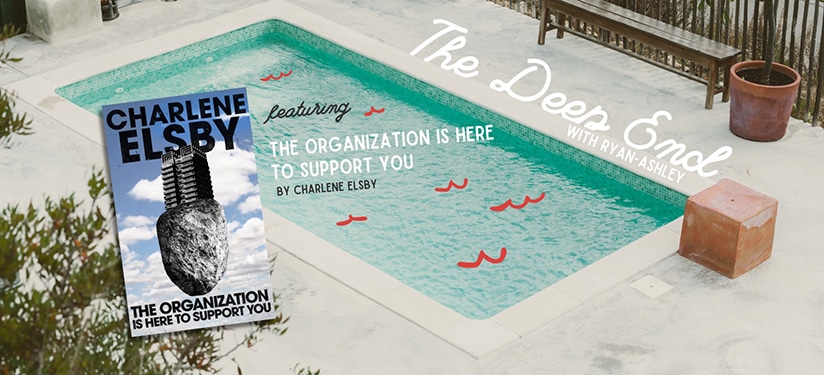
THE ORGANIZATION IS HERE TO SUPPORT YOU, a Review from The Deep End

I was drinking coffee and reading The Organization is Here to Support You. It was the morning, which meant my patience for bullshit was still relatively high. I had been reading it since the night before—tearing through it, really—and had just gotten to page 87 where the book’s most loathsome character, Devin Brault, made a request of the book’s protagonist, Clarissa, which was so disgusting, I found myself involuntarily gagging. Not just gagging on the inside, either, but the open-mouth, I-might-actually-vomit kind of gagging.

As a longtime lover of horror films, I’m used to watching things that terrify me. That make me sick. But I’ve always avoided the really gory body horror stuff until recently. In fact, the last time I even remember reading horror proper was as a kid obsessed with Goosebumps, a glorious franchise my mother made me give up because it wasn’t good for my nightmare condition, and me waking up screaming in the middle of the night wasn’t good for her. 

December of 2024, that changed. I was walking through Powell’s Books in Portland, OR with my partner, Kevin, one day and the cover of Violent Faculties jumped out at me from the shelf. I didn’t know who Charlene Elsby was at the time, but the cover illustration of a person’s tongue being cut in half by what looked like Gingher fabric scissors, gripped me. I didn’t know what I was getting into when I started reading it and, at certain points, I wasn’t sure I’d be able to finish. Just ask Kevin. Multiple times, I put the book down and said, sometimes with tears in my eyes, “I don’t think I can finish it.” But I did finish it. And I’m so glad I did because that book literally haunts me. I find myself returning to it over and over again, pulling out little bits to use in this paper or that about the subjugation and destruction of the female body by the patriarchy under capitalism. 

I was sitting in my corner chair and Kevin was lying on the sofa nearby when the gagging happened. Sensing the disgust on my face, he looked over. “Damn,” he said, “the only other time I’ve seen you do that was when you were reading Charlene’s other book.” Kevin was, of course, referring to Violent Faculties. Then, my gagging was a response to a scene where, during an experiment, the narrator drilled a hole into her female subject’s head (“…in the side of her head, so as not to ruin her pretty face” (50)) so it could be filled with the cum of an anonymous stranger in order to determine whether or not cum, when applied to an open wound, might lead to a longer survival rate. This male stranger—a willing experiment participant—did, indeed, fill the woman’s head-hole with cum after fucking it enthusiastically. She, of course, did not survive. 

I’m now on my third Elsby book and what I love most about her work is that it’s always doing so much. Not only is she writing plot lines that are totally unique (yes, that is uncommon, especially in genre writing which can too easily fall into the trap of formula), creating imagery that is shocking in both its grotesqueness and its inventiveness, but she’s also doing this on the foundation of critical analysis. Elsby’s female characters are deep thinkers. They are animated by the intuition that all is not well, the belief that things could and should be better, and the desire to escape banality and subjugation. They do not want to be part of the system. They may want to be equipped to operate successfully within the system, to get by, but they are suspicious of it. Elsby’s theory-driven critiques are central to her plots and character development and they materialize in ways that are accessible even to readers unfamiliar with the central critiques. 

You don’t have to be a philosophy expert or an anarchist or a socialist or a democrat to shudder at the thought of being subsumed into the machinery of a profit-based organization. The thought is terrifying because it’s not only possible, but likely. Probable. Required, even, to play the game. And, although rarely publicized, all over the world, people actually do live where they work. In many factories, employees live on-site, sleeping in tiny bunks with no privacy, for months at a time because their rural homes are too far away for daily commutes and these factories provide the best employment (or only) options for their families. They have no separation between work and home life and often, few protections. 

Perhaps people who have been working from home since COVID can relate to some part of this. Cleverly, institutions have branded their flexible hybrid and remote employee options as evidence of being people-first organizations. In fact, allowing this benefits the organization far more than the employee. The greater the blur between an employee’s work and home life, the better for the organization. Think of all the overhead they’re saving from employees creating their own physical workspaces, at their own expense, with their own equipment, in order that the companies may save on real estate, utilities, office supplies. Think of the ways in which late-night and weekend texts have become normalized for WFH employees. All this without even a pay raise. Why? Freedom is the benefit. 

The live-at-work life is explicit for our protagonist Clarissa who lives on-site at The Organization. She likes how convenient everything is—that she never has to go far for sustenance, that couriers bring any online purchases directly to her unit, and that she no longer has to contend with the long walk to and from work each day. She likes the security that The Organization has to offer, the feeling that she’s part of something (anybody who lacks a strong family or social community can likely relate to this desire—it’s certainly what drove me to succeed corporately for so long). She also seems to feel comforted by the fact that no matter how little she accomplishes (as long as she accomplishes the bare minimum) or how much, she will always be referred to as “satisfactory.” 

Clarissa, an only child of two deceased parents, craves connectivity, Living at The Organization makes her part of its body, its systems. There’s safety in that. The Organization needs the work done each day that Clarissa does as a level 07, and she prides herself on ending each day in a way that would allow anybody to come in at any moment and just pick up where she left off. There is pride at The Organization in being dispensable. Because that’s what it means to do a good job. Nothing less. Nothing more.

“I take solace in how many officers there are and how,” Clarissa says, “in the event of an emergency, another one of me would take my place. There would be no interruption of my service” (7).

Clarissa goes on to explain that, “It is against every rule of decency to differentiate between us, and especially if that differentiation is an attempt to distinguish a better from a worse” (9), Clarissa explains, and this knowledge frees her from ever feeling compelled to do more than is required. Ego is an unacceptable attribute for a satisfactory employee. At least for, as we see, a female one. 

But Clarissa isn’t necessarily satisfied within The Organization and doesn’t accept the conditions of her employment uncritically. Throughout the text, we are pulled into recollections of conversations with a past lover, Maurice, who talked to Clarissa about freedom and agency. Cleverly, Elsby has created Maurice to be two-dimensional, a character who is able to talk about freedom because he has the privilege to. Clarissa deftly criticizes Maurice’s naivety as early as page two.

“Maurice, when he was around, used to argue that employment is a constraint… But Maurice didn’t know what it’s like to be really constrained. He’d never needed something he didn’t have. Having everything you need, I told him. That’s freedom. And since not all of us are born rich, we have to work.”

From the very beginning, the reader understands that Clarissa is happy to be part of The Organization for the same reason that each of us reading this book is happy to go to work every day. We go because we have bills to pay, and paying those bills allows us to continue to have homes to live in as well as money to do things with friends and take care of medical needs, for example, when they arise. We are happy to do the things—we, the people who were not born and haven’t become rich—that it takes to avoid a disastrous and miserable life. We are willing to do what it takes. We must do what it takes.

Freedom at The Organization is an illusion in the same way that freedom is an illusion under capitalism. Anybody who, unlike Maurice, must work for subsistence, is only free in an abstract way—free to choose between this career or that, this company or that, this specialty or that—but never free to choose not to work. Further, like in life, merit is also an illusion. The lie that hard work and dedication is the antidote to precarity and the assurance of reward, is what keeps us cycling harder and faster over and over in perpetuity while inching toward retirement. Life under capitalism, like life at The Organization, is a maze. Follow the cheese and you’ll never have to look far to meet your basic needs, but don’t expect to ever get far enough ahead to escape. Even the feeling of escape that leaving one job for another provides is an illusion under capitalism, because when profit is the motive, exploitation is foundational. The only way it works is to get more out of an employee than you give. The Organization knows this. 

In addition to serving as a commentary on freedom, financial privilege, belonging, and work-life balance— “We all get to log off eight hours exactly from when we log in…” Clarissa assures us by page five—it’s also a commentary on gender privilege. And this is what brings us back to the source of my disgust.

Devin Brault is The Organization’s quintessential frat-bro. We’ve all known or worked with somebody like him. He’s the type who feels entitled to the spoils that come with experience, but without actually gaining any experience on his own; who discounts the contributions of his female colleagues in order to make his own paltry contributions stand out as grander than they are; and who gets what he wants simply because he’s willing to grab it away from someone else. Reminds me of the two-party political system—the way the conservative party is able to get so much because they’re simply willing to, unabashedly, take it, while liberals expect that it’s actually possible for reason to prevail through the use of methods like patience, argument, and compromise (if you can call those methods). 

I gagged when Devin, an employee five levels below Clarissa started inappropriately delegating tasks to her, claiming it would be easier for her to “just do it” than for him to learn how. Is there anything more enraging than somebody skipping line? The exact moment of gagging came when, after pushing back, Clarissa’s boss encourages her to help him because he’s not yet “up to speed,” even though Devin’s demands clearly result from unabashed laziness rather than a lack of know-how. Even though doing so would prevent Clarissa from fulfilling her own purpose within The Organization, which was to satisfactorily perform the tasks expected of an 07. This creates a glitch—an opportunity—for Clarissa to feel precarious in a role which had previously felt secure. To question things. To become unsettled. The unspoken message her boss is sending is that The Organization is happy to assign two people to one job, which means one of them must be redundant.

Why is this so abhorrent? Because an undeserving man is jumping rank and the wind beneath his wings is the germane knowledge that he will succeed simply because he deigned to punch above his weight. And the ways in which his behavior is being rewarded directly undermines the professionalism of his female superior, Clarissa. But under capitalism, women are meant to be grateful for the job. To not ask for too much. To not expect accolades or to make their male counterparts look less dedicated by trying harder than or doing more than or expecting higher pay than them for better work. Women are meant to be patient and wait their turn and prop up their male counterparts at their own expense—to die to themselves, if you’re Christian, or to kill their egos, if you’re Buddhist.

My gag was one of recognition.

Precarity, obedience, agency, and gender inequity are prevailing themes within this bureaucratic satire, and while I don’t want to give away any spoilers, suffice it to say that in The Organization is Here to Support You, the figurative ‘maze’ is made real and it’s far easier for men to get around.

As Charlene said in an interview with Mae Murray, “I have argued that existence itself is horrific and all it takes to become part of the horror genre is to write down, without a filter, the things that happen.”

Is Devin’s crime really so different than fucking a woman’s head to death? The result is the same in the long run. Just that the hole in the head is quicker. 


You can purchase The Organization is Here to Support You here. To read an excerpt, previously published on Pool Party, click here.

© Copyright - Pool Party